
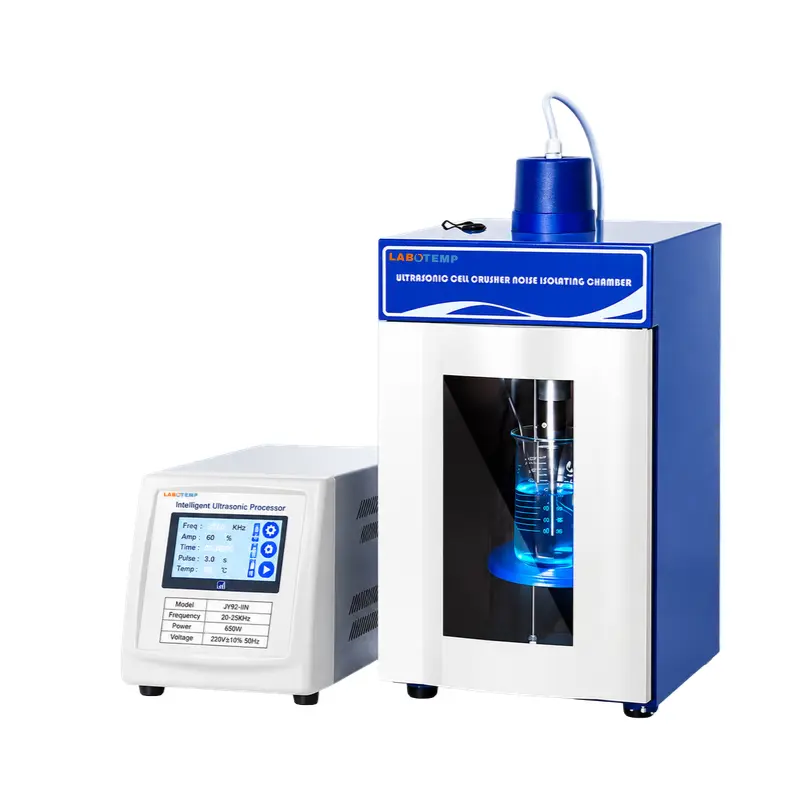
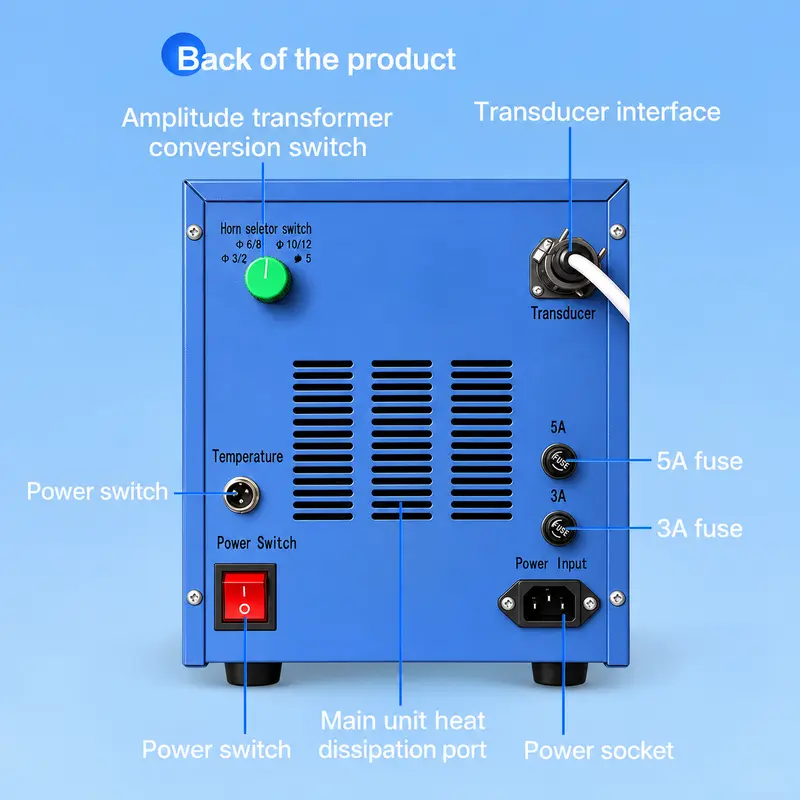
Labotemp Ultrasonic Cell Homogenizer LTH-301 uses ultrasonic cavitation to support cell disruption, homogenization, emulsification, separation, extraction, dispersion and related sample-processing work. Adjustable output power from 1.5 to 150 W and automatic frequency tracking across 20–25 kHz support processing of samples from 0.1 to 150 mL when paired with a suitable probe. Applications documented in supplied manual include biological, medical, agricultural, chemical, pharmaceutical and materials-science research, teaching and production.
4.3-inch TFT touchscreen provides control of power, pulse timing, process duration and sample-temperature settings, with temperature display, automatic fault alarms and protection against overload and overtemperature. Pulse working and interval times adjust from 0.1 to 99.9 seconds, while process timing can be set up to 99 h 59 min 59 s. Twenty parameter groups can be stored. A soundproof enclosure with observation window and adjustable lifting platform houses probe and sample vessel. Host dimensions measure 410 × 225 × 290 mm; enclosure dimensions measure 280 × 280 × 490 mm. Power requirement: AC 220 V ±5%, 50 Hz.
Why Choose Labotemp Ultrasonic Cell Homogenizer LTH-301?
✓Adjustable Ultrasonic Output: 1.5–150 W power setting for varied sample-processing needs.
✓Touchscreen Operation: Set power, pulse timing, duration and temperature parameters.
✓Temperature and Fault Alerts: Temperature monitoring plus overload and overtemperature protection.
| No. | Specification | Value |
|---|---|---|
| General Information | ||
| 1 | Product Name | Ultrasonic Cell Homogenizer |
| 2 | Labotemp Model | LTH-301 |
| 3 | Product Type | Ultrasonic Cell Disruptor / Ultrasonic Homogenizer |
| 4 | Operating Principle | Ultrasonic cavitation in liquid |
| 5 | Control Interface | 4.3-inch TFT touchscreen |
| 6 | Working Mode | Pulsed |
| 7 | Frequency Control | Automatic frequency tracking |
| Ultrasonic Performance | ||
| 8 | Output Power | Adjustable, 1.5–150 W |
| 9 | Working Frequency | 20–25 kHz |
| 10 | Processing Capacity | 0.1–150 mL, depending on probe |
| 11 | Timing Range | 0–99 h 59 min 59 s |
| 12 | Pulse Working Time | Adjustable, 0.1–99.9 seconds |
| 13 | Duty Cycle | 0.1–99.9% |
| 14 | Stored Parameter Groups | 20 |
| 15 | Frequency Adjustment | Automatic tracking |
| Temperature Control and Safety | ||
| 16 | Sample Temperature Control Range | 0–100°C |
| 17 | Temperature Control Accuracy | ±1°C, as stated in supplied product images |
| 18 | Temperature Display | Supported |
| 19 | Alarm Functions | Fault and temperature alarms; manual also lists time alarm |
| 20 | Protection | Overload and overtemperature protection |
| 21 | User Password Protection | Supported |
| Probe and Sample Capacity | ||
| 22 | Probe Diameter | Processing Capacity |
| 23 | Ø2 mm | 0.1–5 mL |
| 24 | Ø3 mm | 3–10 mL |
| 25 | Ø6 mm | 10–100 mL |
| 26 | Ø8 mm | 20–150 mL |
| Dimensions and Weight | ||
| 27 | Host Dimensions (W × D × H) | 410 × 225 × 290 mm |
| 28 | Soundproof Enclosure Dimensions (W × D × H) | 280 × 280 × 490 mm |
| 29 | Net Weight | 12 kg |
| Electrical Requirements and Environment | ||
| 30 | Power Supply | AC 220 V ±5%, 50 Hz, according to manual |
| 31 | Operating Ambient Temperature | 0–40°C |
| 32 | Installation Environment | Well-ventilated location |
| 33 | Environmental Precautions | Protect against corrosion, moisture, direct sunlight and dust |
Cell Disruption: Supports disruption of biological cells using ultrasonic cavitation.
Bacterial and Microbial Processing: Suitable for laboratory processing of bacterial and other microbial samples, with settings optimized for each sample.
Tissue Sample Processing: Supports ultrasonic processing of animal and plant tissue samples.
Homogenization: Helps produce more uniform mixtures through ultrasonic processing.
Emulsification: Supports dispersion of immiscible liquid phases during laboratory preparation.
Extraction: Supports ultrasonic extraction procedures for suitable laboratory samples.
Dispersion: Helps disperse particles in liquid samples, subject to sample and probe selection.
Separation: Supports laboratory sample preparation involving ultrasonic treatment.
Pharmaceutical Research: For suitable research and sample-preparation workflows in pharmaceutical laboratories.
Agricultural Research: Supports laboratory processing of relevant agricultural and plant samples.
Materials Science: Supports dispersion and nanomaterial preparation workflows described in the manual.
Teaching and Research: Suitable for laboratory education, experimentation and research applications.
