
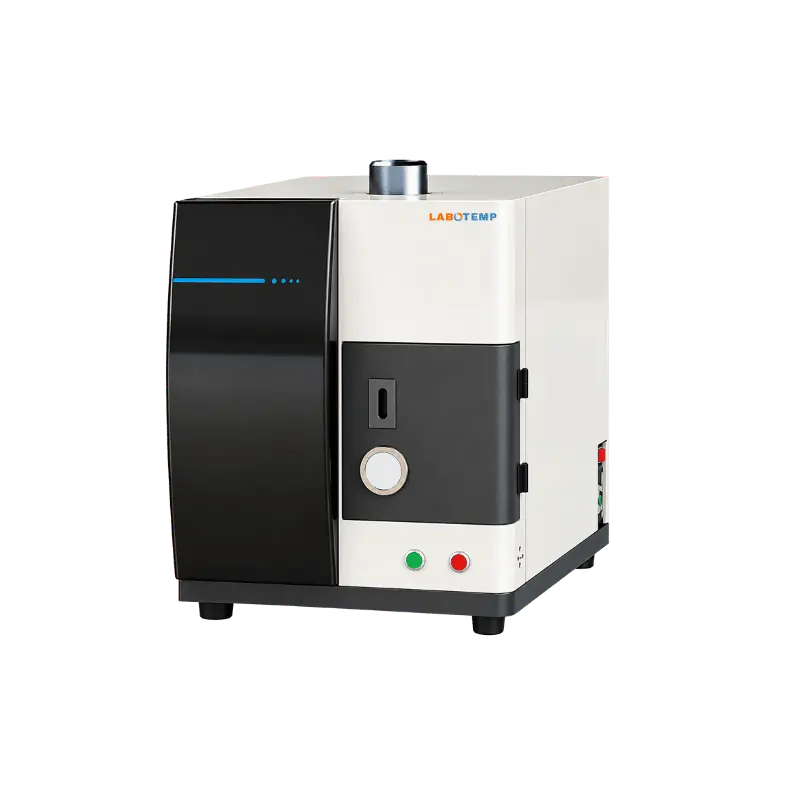
Labotemp Rotating Disc Electrode Oil Spectrometer LES-101 delivers rapid, simultaneous multi-element analysis for evaluating wear metals, contaminants, and additives in industrial oils and liquids. Using rotating disc electrode atomic emission spectroscopy (RDE-AES), this analytical instrument supports the assessment of lubricating oil, hydraulic oil, fuel oil, grease, antifreeze, cooling water, and electrolytes. Its analysis time of tens of seconds and sample injection volume of up to 2 mL make it suitable for routine oil testing and industrial equipment condition monitoring.
Designed for reliable elemental analysis, the LES-101 features a high-sensitivity CMOS array detector, a 201–810 nm spectral range, and a thermally stabilized optical system with adjustable temperature control at 37°C ±0.1°C. Its integrated oil analysis software supports element identification, calibration, interference correction, trend analysis, and historical data tracking. The instrument requires no gases or cooling water and operates with an AC arc excitation system, helping laboratories streamline testing workflows. It supports preventive maintenance, lubricant quality control, and monitoring of wear-related contaminants in industrial equipment, power systems, and other applications involving oil and fluid analysis.
Why Choose Labotemp Rotating Disc Electrode Oil Spectrometer LES-101?
✓ Rapid Multi-Element Analysis: Analyzes multiple elements simultaneously within tens of seconds.
✓ Advanced Detection System: Combines a high-sensitivity CMOS array detector with a 201–810 nm spectral range.
✓ Intelligent Oil Analysis Software: Supports calibration, interference correction, elemental measurement, trend analysis, and historical data tracking.
| No. | Specification | Value |
|---|---|---|
| General Specifications | ||
| 1 | Product Name | Rotating Disc Electrode Oil Spectrometer |
| 2 | Model | LOS-101 |
| 3 | Product Type | Rotating Disc Electrode Atomic Emission Spectrometer (RDE-AES) |
| 4 | Sample Types | Lubricating oil, hydraulic oil, fuel oil, grease, antifreeze, cooling water, electrolytes |
| 5 | Analytical Elements | Al, Ba, B, Ca, Cr, Cu, Fe, Pb, Mg, Mn, Mo, Ni, K, Na, Si, Ag, Sn, Ti, V, Zn, etc. (extensible) |
| Optical System | ||
| 6 | Optical Structure | Paschen-Rungel |
| 7 | Spectral Range | 201–810 nm |
| 8 | Focal Distance | 400 mm |
| 9 | Detector | High-Sensitivity CMOS Array |
| 10 | Temperature Control | Thermally Stabilized; 37°C ±0.1°C (Adjustable) |
| Working Parameters | ||
| 11 | Operating Temperature | -10°C to 40°C |
| 12 | Storage Temperature | -40°C to 65°C |
| 13 | Operating Humidity | 0–95% RH, Non-Condensing |
| 14 | Sample Injection Volume | ≤2 mL |
| 15 | Injection Mode | Rotating Disc Electrode |
| 16 | Output Type | AC Arc |
| Power Specifications | ||
| 17 | Power Supply | 220V/50Hz and 110V/60Hz |
| 18 | Power Consumption | ≤500 W |
| Consumables | ||
| 19 | Top Electrode | Spectral-Purity Graphite Rod Electrode |
| 20 | Bottom Electrode | Spectral-Purity Graphite Disc Electrode |
| 21 | Sample Cup | High-Temperature Oil Cup |
| 22 | Standard Oil | 0 ppm, 10 ppm, 50 ppm, 100 ppm, etc. |
| 23 | Standard Solution | 1000 ppm |
| Physical Specifications | ||
| 24 | Internal Dimensions (W × H × D) | 500 × 720 × 730 mm |
| 25 | Packaging Dimension(W × H × D) | 950 ×700 × 950 mm |
| 26 | Net Weight | 82 kg |
| 27 | Gross Weight | 140 kg |
| Analysis Software | ||
| 28 | Software Functions | Element Identification, Measurement, Real-Time Calibration, Interference Correction, Trend Analysis, Automatic Oil Condition Diagnosis, Historical Data Tracking |
| Additional Features | ||
| 29 | Analysis Time | Tens of Seconds |
| 30 | Gas Supply Required | No |
| 31 | Cooling Water Required | No |
| 32 | Sample Preparation | No Sample Dilution or Preheating Required |
Industrial Oil Condition Monitoring: Detects wear metals and contaminants in lubricating oils to help assess equipment condition and support preventive maintenance.
Lubricant Quality Control: Analyzes elemental composition in lubricating oils to support quality control and monitor contamination.
Fuel Quality Analysis: Measures contaminants in fuel oils, including fuels used in gas turbines and diesel engines.
Hydraulic System Monitoring: Evaluates wear metals and contaminants in hydraulic fluids to support equipment condition assessment.
Cooling System Monitoring: Measures elemental concentrations in antifreeze and cooling fluids used in industrial systems.
Industrial Water Analysis: Supports elemental analysis of power plant cooling water and turbine wash water for condition monitoring and disposal or reuse assessment.
Power Industry Applications: Helps monitor metallic contaminants, including copper and iron, in mineral insulating oils.
Aviation and Aerospace Fluid Analysis: Supports wear-metal analysis in aviation working fluids.
