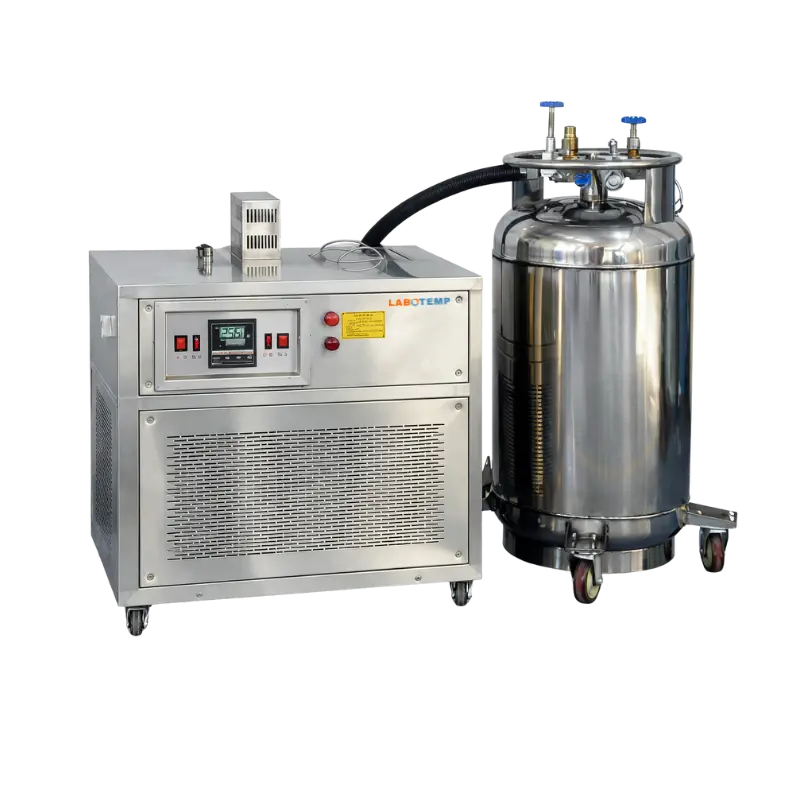
Labotemp Cryogenic Test Chamber CTC-05 Low-Temperature Impact Testing Chamber is a precision liquid nitrogen–cooled test chamber designed for controlled low-temperature impact testing of materials in accordance with international standards. Operating over a wide temperature range from +30°C to –196°C, this system is widely used for specimen conditioning prior to pendulum impact tests such as Charpy where accurate temperature control is critical to reliable material performance evaluation. The chamber applies a heat-balance circulation principle combined with forced air convection to ensure uniform cooling and stable specimen temperature before testing.
Liquid nitrogen refrigeration enables rapid cooling, while digital temperature resolution of 0.1°C allows precise control during specimen conditioning. The chamber accommodates up to 60 specimens, supports independent sample loading without disturbing other specimens, and uses an imported cryogenic solenoid valve for stable cooling performance.
Why choose Labotemp Cryogenic Test Chamber CTC-05?
✓Ultra-low temperature range: Reliable conditioning down to –196°C
✓Uniform cooling: Circulating airflow ensures consistent specimen temperature
✓Standards compliant: Designed for international impact testing requirements
| Model | CTC-05 |
|---|---|
| Temperature Range | +30° C to -196° C |
| Temperature Control Accuracy | ±2° C |
| Cold Room Volume (L × W × H) | 275 × 160 × 120 mm |
| Overall Dimensions (L × W × H) | 710 × 600 × 740 mm |
| Chamber Material | Stainless Steel |
| Specimen Capacity | More than 60 specimens |
| Digital Timer | 1 min to 9999 min (Resolution: 1 min) |
| Refrigeration Method | Liquid nitrogen refrigeration |
| Cooling Medium | Liquid nitrogen |
| Power Consumption | 100 W |
| Remarks | Cold room volume can be customized according to customer requirements |
This low-temperature impact testing chamber is used for specimen cooling and insulation in Charpy impact testing under ultra-low temperature conditions. It is suitable for metallurgical laboratories, materials testing centers, quality control departments, and research institutions, and can also be applied to other low-temperature detection and testing requirements.